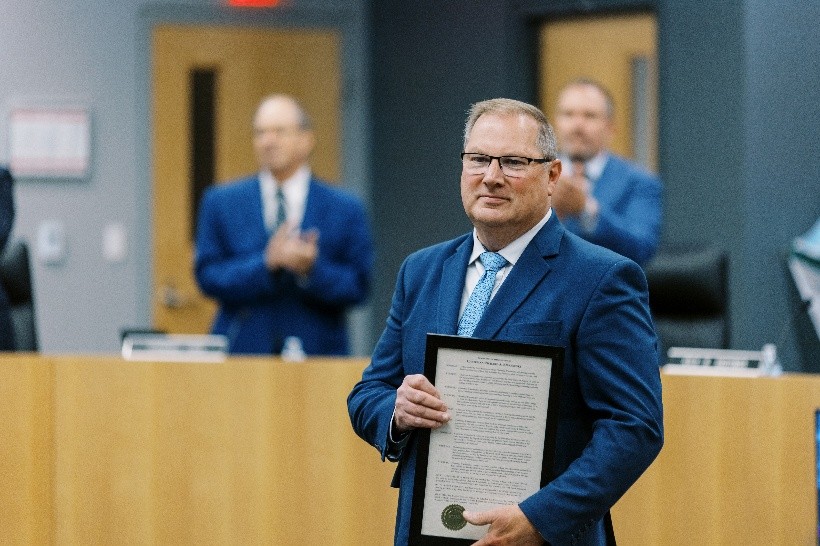
Pace Chairman Rick Kwasneski is pictured receiving a resolution honoring his 24 years of service to Pace.
Longtime chairman guided Pace through decades of growth as agency transitions to restructured 11-member board under new regional transit governance law
ARLINGTON HEIGHTS, IL — Pace Chairman Richard A. Kwasneski will retire after 24 years of service on the Pace Board of Directors. Today marks his final day as chairman, closing a distinguished chapter as Pace’s longest-serving Board chairman and coinciding with the agency’s transition to a new era of regional transit governance under the Northern Illinois Transit Authority (NITA) Act.
Kwasneski’s retirement comes as Pace transitions to a restructured Board beginning September 1. During more than two decades on the Board, he helped guide Pace through major service improvements, capital investments, technology upgrades, and new mobility options designed to better connect people across Cook, DuPage, Kane, Lake, McHenry, and Will counties. His tenure included the continued development of Pace’s family of services, expansion of innovative programs, and long-range planning efforts that positioned the agency to meet changing travel needs across a large and diverse suburban region.
“Chairman Kwasneski has been a steady and deeply committed leader for Pace, its riders, and the communities we serve,” said Pace Executive Director Melinda Metzger. “For 24 years, he has brought a clear understanding of suburban mobility needs, a strong commitment to fiscal responsibility, and a genuine belief in the role public transportation plays in connecting people to opportunity. Pace is stronger because of his service.”
As chairman, Kwasneski supported initiatives that strengthened Pace’s role as both a transit operator and a mobility innovator, including investments in cleaner vehicles, customer-facing technology, accessible service, rapid transit corridors, express service, and first- and last-mile connections. His leadership helped advance major agency priorities, such as Driving Innovation, ReVision, Pulse, and Project Zero, as well as ongoing efforts to provide safe, reliable, accessible, efficient, and environmentally responsible service.
As part of the changes established under the NITA Act, a new regional framework is intended to improve coordination, accountability, planning, and funding across Pace, CTA, and Metra while preserving each service board’s focus on day-to-day operations and rider needs.
“It has been an honor to serve Pace and the people of northeastern Illinois,” said Pace Chairman Richard A. Kwasneski. “Public transportation is essential to the strength of our communities, and I am proud of the work we have done to expand service, modernize the agency, and build a strong foundation for the future. I am grateful to my colleagues on the Board, Pace’s staff, and the many partners who share a commitment to improving mobility across the region.”
Pace will continue to work with its new Board, regional partners, and local communities to strengthen service and advance projects that support riders across the six-county suburban service area. As the agency enters this next era, Kwasneski’s years of leadership will remain part of Pace’s strong foundation.
###
Pace Suburban Bus safely and efficiently moves people to work, school, and other regional destinations with its family of public transportation services. Pace offers affordable and environmentally responsible transit options for the residents of 274 municipalities in Cook, Will, DuPage, Kane, Lake, and McHenry counties. The backbone of Chicago’s suburbs, Pace serves tens of thousands of daily riders. One of the largest bus services in North America, Pace covers 3,677 square miles, an area about 15 times the size of the City of Chicago. Pace’s innovative approach to public transportation gives the agency a national reputation as an industry leader.